
Are you working for an incoherent organization?

In my strategy consulting work, I often encounter clients whose organizations are not coherent. That sounds bad, and it is!
co-her-ent
adjective
(of an argument, theory, or policy) logical and consistent.
United as or forming a whole
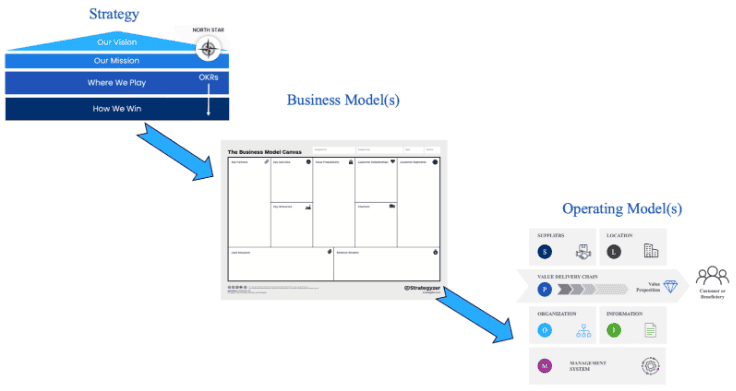
The incoherence I encounter in companies is a lack of consistency between the company’s strategy as compared to the business models and operating models they have implemented. Often, there are inconsistencies within and between elements of their business and operating models with different elements optimized for different goals. Consequently, elements of the business and op models are working at cross-purposes and undermining one another, as well as impeding corporate strategic objectives.
In my forthcoming book published by Wiley, Adapt to Win: A Framework to Overcome Strategy Decay Using OKRs and Lean Portfolio Management, I present a steel thread set of principles, rules, practices and tools from top level corporate strategy down through every node of the organization. My approach ensures that funding of initiatives and investments, and all the work performed by employees are all focused and aligned to realize the firm’s strategic objectives.
The book also addresses the imperative of organizational coherence—the need for business models and operating models to be aligned and optimized to realize the company’s strategic objectives. While this seems like common sense, it is extremely common that organizations allow departments to optimize locally for objectives different from or even antagonistic to those designed to realize the company’s strategy.
An Example of an Incoherent Business Model
A company where I was VP of Product Development whose primary revenue source was software and related services was struggling to overcome a legacy of being more of a custom development and professional services firm and advance its strategic objective to become a true SaaS software product company in preparation for an IPO. Its sales organization was habituated to pitching custom features instead of product value and vision. Salespeople were incented to write contracts that included one-off custom features with unrealistic due dates. The company’s incentives and lack of leadership alignment resulted in “product” development always being overcommitted for nonstrategic features it didn’t have the capacity to deliver. Product managers had product roadmaps, but strategic features were rarely prioritized given perpetual customer delivery emergencies.
The company sold dozens of software modules and components serving dozens of use cases, but there was no coherent packaging of those modules into standardized bundles that marketing could promote with a cohesive value proposition and sales could quote—every sales opportunity was a slow, painful, confusing custom configuration and pricing exercise for a massive, one-time perpetual license revenue hit. Customer support was a nightmare with dozens of unique versions of the “product” running in production.
Incoherent business and operating models result from senior leaders failing to create effective strategy implementation processes for the organization.
Defining standard bundles of components targeted for important usage scenarios, markets and personas and devising standardized subscription pricing for each allowed the entire organization to go to market in a productized manner. Transitioning the existing customer base to one standardized code base that was versioned, supported and upgraded consistently was difficult, but reduced support costs and enabled the company to scale without proportionally increasing costs. The transition to bring the business model into line with the strategy took a lot of discipline to navigate, given there were painful short-term revenue and business model adjustments, as well as a large number of employees who were habituated to the old way of working, but these changes ultimately improved brand perception, created a lovely stream of recurring revenue with better operating margins, and streamlined sales cycles.
An Example of Strategy / Operating Model Incoherence
One common failure to align the company’s op model to strategic objectives is creating a low-cost product delivery model in a company that has a strategy and value proposition (business model) targeting high value, highly responsive, highly differentiated premium products. I’ve consulted for many companies that laid off experienced and knowledgeable development staff and replaced them with low-cost offshore contractors. While the cost per labor hour is undeniably less, the delays, misunderstandings, additional documentation detail, higher escaped defect rates and lack of customer and product knowledge inevitable with an outsourcing vendor more than offset any cost savings. Less value is delivered per developer dollar invested (of course, cost per labor hour is easier to measure than value delivered or even productivity).
Operating models for commodity IT-style software maintenance optimize for low cost but trade for lower value, lower productivity, lower quality output. This may be appropriate for a corporate cost center. IT cost centers don’t mind de-leveraging employee knowledge capital because the customers are internal and the stakes for mediocrity are low.
Product development optimizes for effectiveness—high value, high impact software that drives the lifeblood of the company. A product development profit center realizes the strategy of the company by enabling competitive advantage, sustained growth and profits. Product effectiveness is built on innovation, iteration, and experimentation building upon deep understanding and empathy for the customer, maximized by investing in the company’s employee knowledge capital.
I find that the alignment the CEO assured me existed at the beginning of the engagement evaporates when making hard decisions that clarify some things the company is not going to fund and support.
While it can be completely rational for an organization to optimize IT delivery for low cost / low value, for a software product company that seeks to compete and stay in business for the long term it is usually a false economy to jettison the experience and talent of knowledge workers. Examine your strategic objectives and business models, then optimize your delivery op model to be coherent with the strategy.
Other common types of incoherent business or operating models include:
- Business models that encourage sales of legacy products over new products when new products support the strategic objectives of the firm but may also cannibalize legacy revenue streams for a parochial P&L leader or offer salespeople lower commissions or a tougher close.
- Supply chain management and procurement policies designed for high volume economies of scale and low-cost components, in spite of the company’s strategy depending upon low volume, high value products requiring responsiveness and rapid innovation.
- Misaligned local optima determining models for talent acquisition, employee performance management and rewards, funding and budgeting processes, reporting structures and org design, manufacturing and sourcing, distribution and sales, and all the other elements of business and operating models.
How Do Organizations Become Incoherent?
Incoherent business and operating models result from senior leaders failing to create effective strategy implementation processes for the organization. It’s possible that:
- Leaders formulated a brilliant strategy but underinvested in deploying that strategy to the organization with clear and relevant goals and measures.
- Leadership failed to ensure that all elements and functions of the organization devised goals and measures that aligned up to corporate objectives.
- They failed to ensure objectives were aligned horizontally across the silos to support collaboration and cooperation.
- Business model and operating model design was something that senior leaders left to their lieutenants, assuming that their VPs wouldn’t use their control over departmental goals and rewards to optimize their silos locally, prioritizing parochial outcomes that are at odds with global objectives.
- The strategy execution tracking and governance process is so weak that the failure of one or more departments to meet dependencies goes unnoticed, causing cascading failures of strategic initiatives. Often, the repeated failure of corporate strategic initiatives (70% of corporate strategic initiatives fail) goes unexamined and unaddressed for years.
Don’t assume that even your VPs really understand your strategy, unless you continuously renforce and validate that they do. The state of competence in strategy deployment in the corporate world is dismal, even at the VP level, and it deteriorates rapidly down the organization from there:
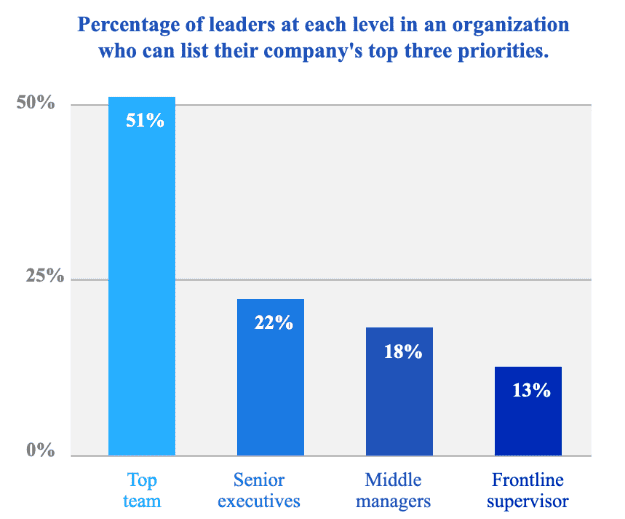
Superficial alignment of executives on a vague strategy is something I encounter frequently. Often, when refining the strategy with them so that it can be effectively deployed, I find that the alignment the CEO assured me existed at the beginning of the engagement evaporates when making hard decisions that clarify some things the company is not going to fund and support. This reconning is a prerequisite to aligning strategic objectives and optimizing business and operating models successfully.
When the critical functions represented in the business and operating models are designed at odds with one other, conflict and dysfunction are inevitable. Don’t be surprised that your business and operating models are actively undermining the strategic success of your firm if senior leadership isn’t constantly refining and aligning them, optimizing them to deliver strategic intent and objectives of the firm.
Learn more about strategy implementation and optimizing business and operating models by contacting Adaptivity LLC, and learn more about my new book at www.adapttowin.co